

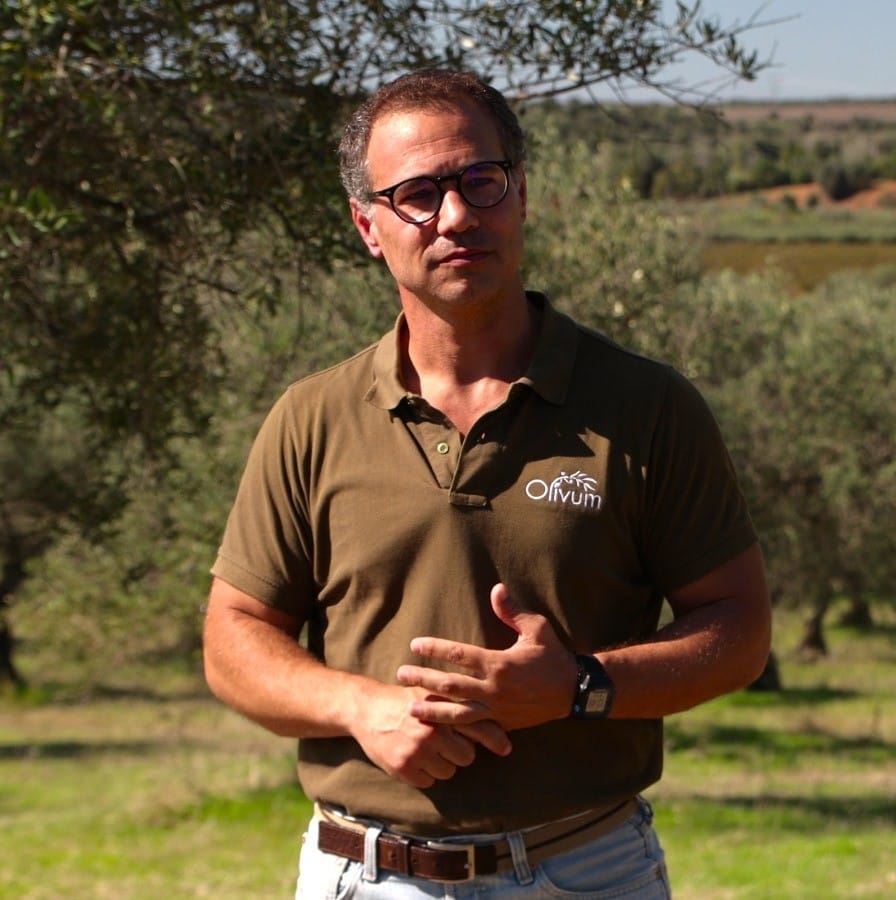
Autor: Gonçalo Moreira: Manager of OLIVUM – Association of Olive Growers and Oil Mills of Portugal
There are foods that go into a recipe, and there are foods that help to define a country. Olive oil belongs to the latter category. It is the very essence of Portugal even before it reaches the plate: it begins in the landscape, passes through agriculture, goes through the mill and arrives at the table carrying aromas and flavours, memory and identity.
For a long time, we have treated olive oil as an unassuming ingredient, using it almost instinctively without giving its value a second thought. We use it in stir-fries, soups, cod dishes, ‘açordas’, salads and even in desserts, but we rarely give it the prominence it deserves. We talk about a wine’s origin, grape variety, vintage and food pairings, whilst we often serve olive oil without mentioning its origin or history, and without explanation. This contrast does not do justice to a Olive oil is a health-promoting food, whose benefits are enhanced in a balanced, varied diet based on minimally processed foods, such as the Mediterranean diet. Its richness in monounsaturated fat and natural compounds makes it a high-quality choice.
But the message must be: no single food, on its own, can remedy an unbalanced diet.
Olive oil promotes good health when it forms part of a way of eating that emphasises vegetables, pulses, cereals, fruit, fish, moderation and socialising around the table. It is precisely this combination that makes the Mediterranean Diet so fascinating. It is not a rigid list of foods, but a relationship between the local area, seasonality, cuisine, sharing and common sense. Olive oil is the element that links many of these dimensions. It encompasses the produce of the land, brings out and enhances flavours, gives recipes their identity and accompanies moments of togetherness. At the Portuguese table, it is both food and culture.
The importance of olive oil, however, begins long before it reaches the kitchen. The olive tree shapes much of the national landscape and preserves the history of rural communities. There are ancient olive groves that bear witness to centuries of labour, varieties specific to particular regions, and mills that recount the technical evolution of several generations. There are also modern olive groves and advanced processing facilities, which demonstrate the capacity for innovation of a sector that has managed to grow, become more efficient and produce high-quality products.
Tradition and modernity should not be seen as opposites. Both are part of the history of Portuguese olive oil. Preserving our heritage, protecting the landscape and promoting local practices does not mean rejecting technology. It means ensuring that the sector’s development maintains a clear connection to the land, the people and the culture that give it meaning.
It is in this promotion that the restaurant sector has a crucial responsibility. For many Portuguese people and visitors, restaurants are the main point of contact with our cuisine. A professional who knows how to present an olive oil, explain its origin and suggest its use transforms a meal into a sensory experience of discovery. A small tasting, an olive oil menu or a well-thought-out pairing can create lasting memories, spark curiosity and foster respect for the product.
OLIVUM, in partnership with AHRESP and with the support of the IOC – International Olive Council, has developed the project ‘Olive Oil in Action: Restaurants as Ambassadors for Portuguese Olive Oil’, with the aim of educating catering professionals so that they can promote and communicate accurately, showcasing the diversity of Portuguese olive oils. (see de video here). As part of this initiative, OLIVUM and AHRESP invited catering professionals to sessions under the Olive Oil in Action project, dedicated to promoting Portuguese olive oil in gastronomy.
Portugal does not just need to produce olive oil of the highest quality. It needs to know how to choose it, store it, use it, serve it and talk about it. When this happens naturally in our homes, schools and restaurants, olive oil will cease to be merely a common ingredient. It will be recognised for what it has always been: one of the most complete expressions of contemporary Portuguese culture and the Mediterranean diet.

