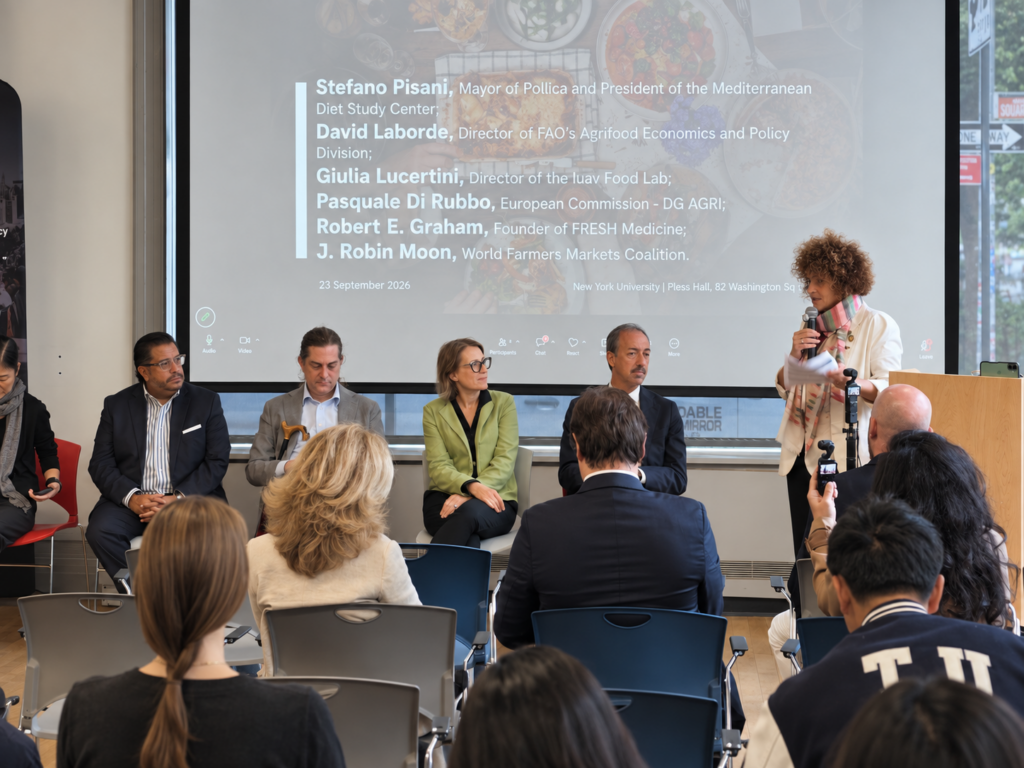
At NYU during Climate Week, the Mediterranean Diet brought diplomacy, public health, farming and territorial planning into one conversation. The challenge now is to turn recognition into everyday change.
What use is sound nutritional advice if a family cannot afford to follow it? And what future does a celebrated food heritage have if the people who sustain it can no longer make a living?
These questions sit at the heart of the Mediterranean Diet’s relevance today. They also shaped “Food for Health, Food for Earth”, held at New York University on 23 September 2026, during Climate Week NYC and the United Nations General Assembly week.
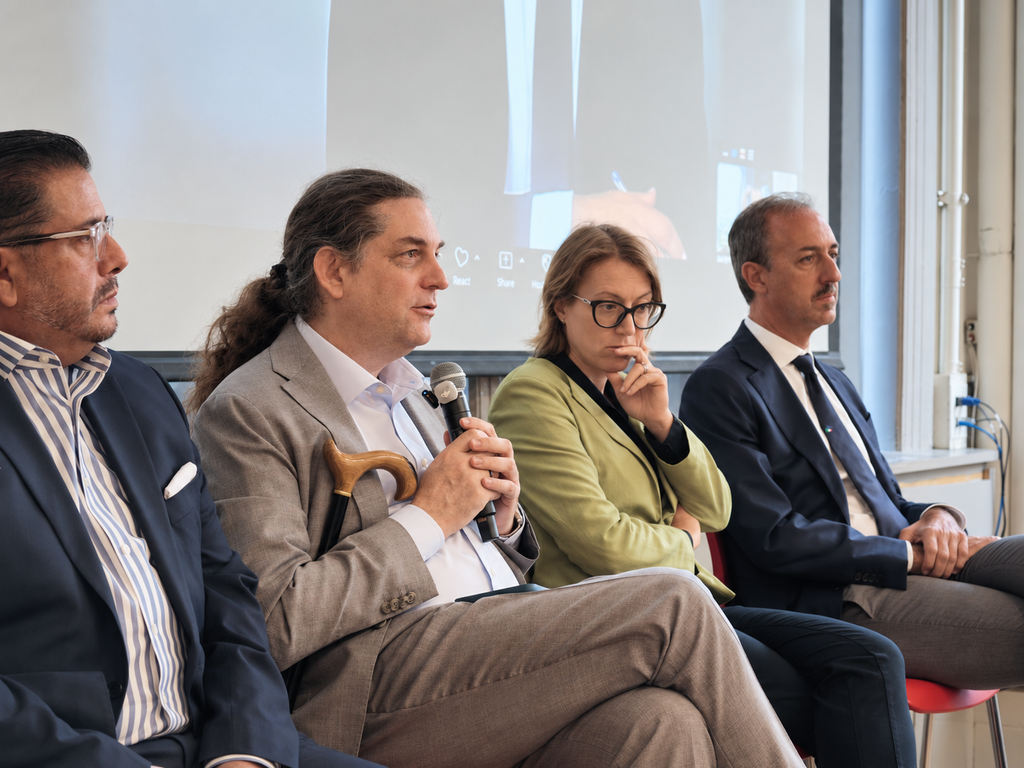
Convened by NYU Steinhardt’s Office of Global Affairs, Future Food Institute and the Mediterranean Diet Study Center of Pollica, the gathering connected international institutions with municipal leadership, medicine, research and farmers markets. Its central proposition was clear: protecting the Mediterranean Diet requires public decisions that make healthy food accessible, sustain producers and care for the places on which both depend.
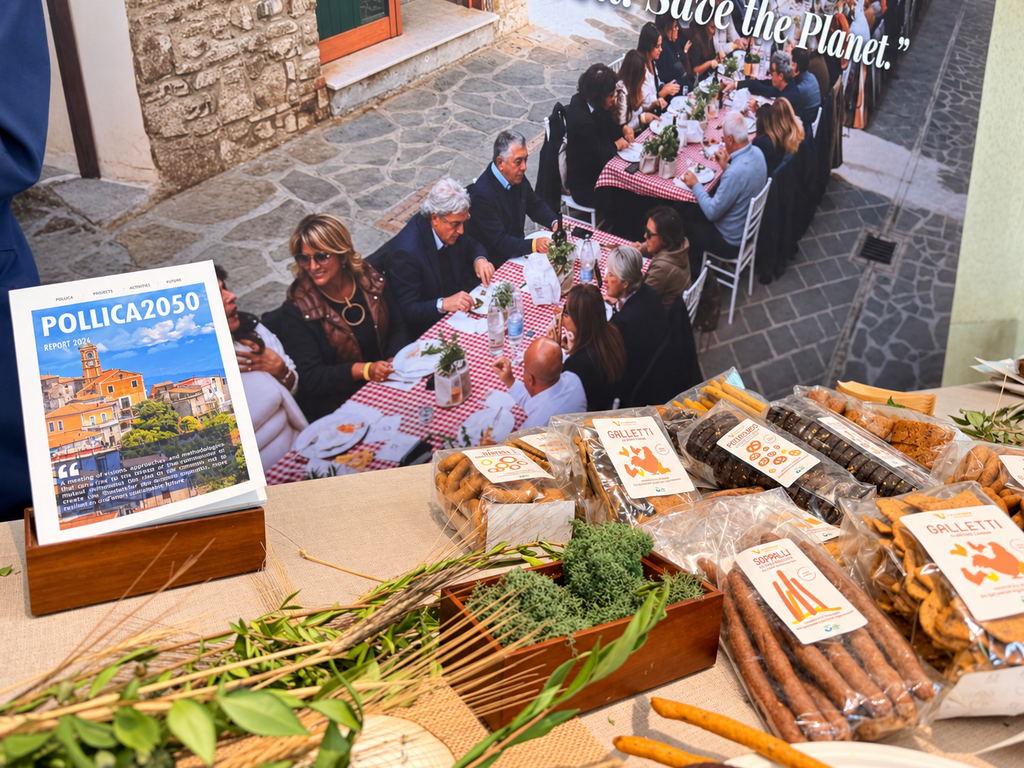
Pollica brought that proposition into focus. The community in southern Italy’s Cilento region offered a place in which to examine how culture, education, livelihoods and health can reinforce one another, and what it takes to keep those relationships alive.
A community recognised, a responsibility shared
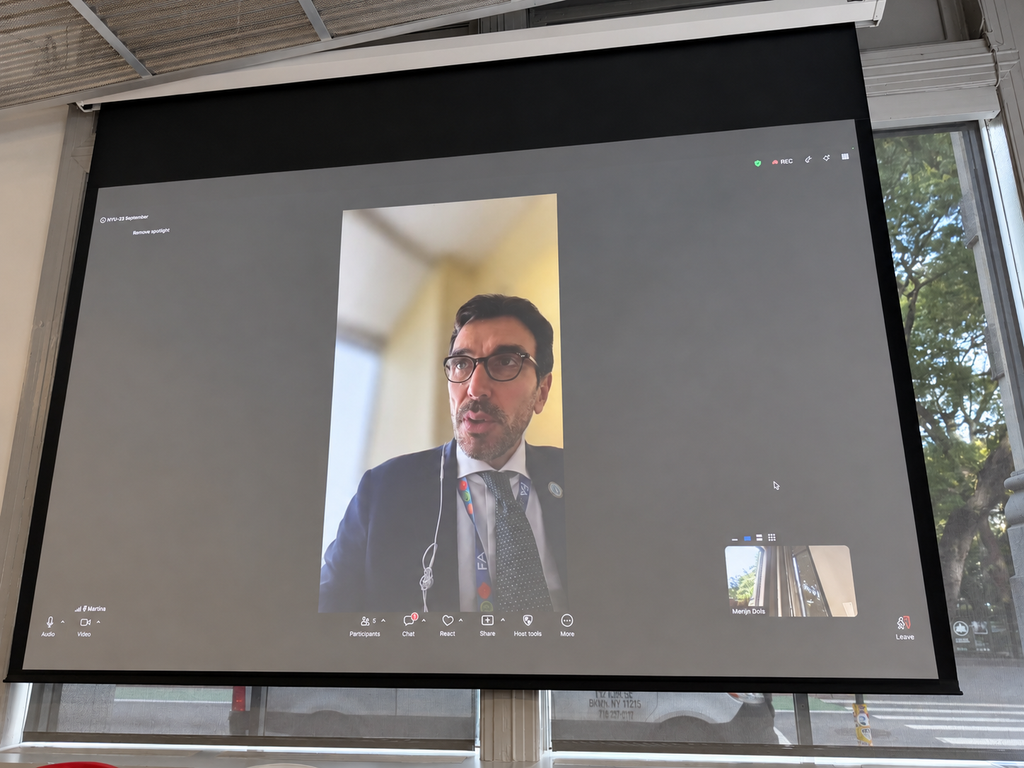
During the event, FAO Deputy Director-General Maurizio Martina announced the recognition of the community of Pollica among the Food Heroes for World Food Day 2026.
The recognition belonged to a community. FAO’s account of Pollica highlighted the farmers, fishers, cooks, artisans, families and local institutions who sustain the Mediterranean Diet through everyday work. It acknowledged the knowledge carried through cultivation, fishing, cooking and shared meals, and the responsibility of passing it to another generation.
For Pollica, the announcement was a moment of collective pride. Its wider significance was equally important: an international institution had recognised the people and relationships that make a healthy food culture possible. Those relationships deserve a place in policy alongside the nutritional qualities of the food itself.
The setting reflected a relationship built over years. Lisa Sasson, Associate Dean for Global Affairs and Experiential Learning and Clinical Professor of Nutrition and Food Studies at NYU Steinhardt, has developed a deep connection with Pollica. In her welcome, she acknowledged the sustained commitment of the mayor and the community, and their role in representing the Mediterranean Diet internationally.
That connection between a university and a community matters. Learning about food also means encountering the people who grow it, the places that shape it and the social practices through which knowledge is shared.
Diplomacy with a task beyond recognition
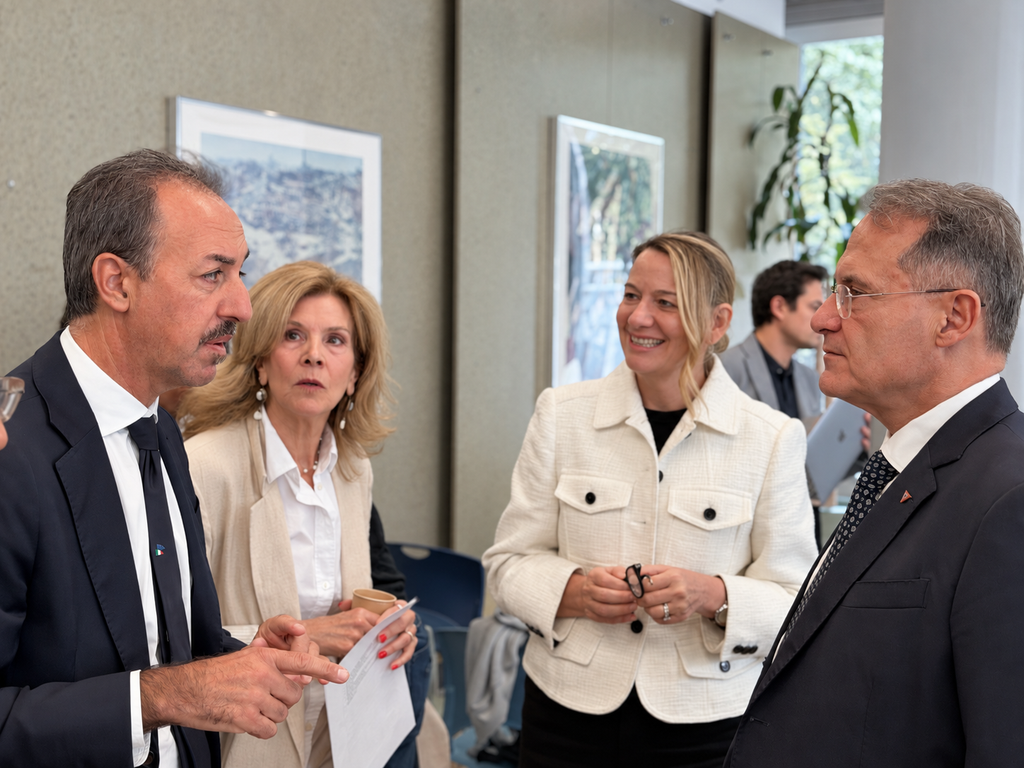
Edmondo Cirielli, Italy’s Deputy Minister of Foreign Affairs and International Cooperation, connected the discussion to the Cilento region, research on longevity and Italy’s commitment to sustainable development through international cooperation.
His call to turn recognition into lasting action referred to the establishment of the International Day of the Mediterranean Diet. The UN General Assembly designated 16 November as the annual observance in December 2025, following an initiative promoted by Italy together with other Mediterranean countries. Its first observance will take place on 16 November 2026.
This is a separate milestone from Pollica’s Food Heroes recognition. Together, they raise a practical question: what should recognition enable communities and institutions to do next?
The work of Italy’s Permanent Representation to the United Nations, alongside the support of the Italian Consulate General in New York, underlined the continuity that diplomacy requires. For the Mediterranean Diet community, that work opens opportunities to share evidence, strengthen cooperation and bring local experience into international decisions.
The heritage itself is shared across borders. Its future depends on cooperation that respects different food cultures and gives communities an active role in shaping how their knowledge is represented and used.
Healthy diets must be affordable to eat and viable to produce
David Laborde, Director of FAO’s Agrifood Economics and Policy Division, brought the economics of healthy diets into the conversation. Affordability is the point at which advice meets household reality. Food security discussions must address whether people can obtain a varied, nourishing diet, as well as whether enough food is available.
The implication is uncomfortable but necessary: promoting healthy eating while leaving its economic barriers untouched can deepen the distance between those who have choices and those who do not.
Pasquale Di Rubbo, from the European Commission’s Directorate-General for Agriculture and Rural Development, connected the discussion to agricultural policy. Farmers’ incomes, opportunities for younger generations and the protection of natural resources belong in the same conversation as the price paid by a family.
The European Commission’s Vision for Agriculture and Food provides a relevant policy context, linking viable livelihoods with resilience and the future of rural communities. Cheap food achieved by weakening producers or exhausting soil and water cannot provide a lasting foundation for public health. The task is to make nutritious food affordable while enabling those who produce it to thrive.
What changes when food becomes a planning decision?
Stefano Pisani, Mayor of Pollica, brought the perspective of an administration working to connect heritage, education and local development. A municipality encounters food through very concrete responsibilities: school meals, public space, support for local enterprise, care for landscapes and opportunities for young people.
Giulia Lucertini, from the Food Lab at Iuav University of Venice, added the perspective of territorial planning. The relationship between cities and countryside, the location of markets and the organisation of land and infrastructure all shape what people can buy and what producers can sell.
Seen together, these perspectives shift the question from what an individual should eat to what a place makes possible. Is fresh food within reach? Can a small producer access a market? Do public meals create demand for diverse, seasonal ingredients? Can children learn about food through direct experience?
Sara Roversi, Founder and President of Future Food Institute, brought the educational and community dimension of this work. Through Paideia Campus, the Institute works with Pollica’s municipality and community to connect research, learning and territorial action. Gardens, kitchens, the coast and encounters with producers become places where the relationships between food, culture and ecology can be understood and practised.
Pollica offers an example to study and adapt. New York has its own communities, landscapes and food traditions. The useful exchange concerns the conditions that allow those cultures to support health, dignity and ecological responsibility.
From the clinic to the farmers market
Robert E. Graham, physician, chef and founder of FRESH Medicine, brought clinical practice into the discussion through the relationship between food, everyday habits and care. Roberto Vicinanza, of the University of Southern California’s Leonard Davis School of Gerontology, contributed the scientific perspective on the Mediterranean Diet and ageing.
Their contributions placed prevention and health across the life course within the wider conversation. The practical challenge is to connect nutritional knowledge with the circumstances in which people actually live, shop, cook and eat.
J. Robin Moon brought the work of the World Farmers Markets Coalition into this picture: training, exchanges of practice and international cooperation to strengthen farmers markets. She recalled the example of Coldiretti and Campagna Amica bringing markets into Italian hospitals, connecting agricultural work with a collective effort towards prevention and healthier food.
The initiative, developed with partners including Fondazione Aletheia and participating hospitals, offers a tangible meeting point between agriculture and healthcare. Producers enter places associated with treatment, while patients, families and health workers encounter the relationship between food and prevention.
A market’s contribution still depends on how it works: who can afford to shop there, whether producers receive fair returns and whether it serves the everyday needs of its community. These are questions of public health and local economic development as much as retail.
The work ahead of 16 November
The event’s accompanying policy materials set out a practical direction: improve public meals, support accessible community markets, connect food education with lived experience, protect biodiversity and local knowledge, and measure whether policies change people’s lives.
These are areas for action, rather than outcomes that a single gathering can claim. A university can examine its food purchasing. A city can connect school meals with education and regional producers. A health institution can strengthen its relationship with the people supplying nutritious food. Each needs clear responsibilities and evidence of progress.
As the first International Day of the Mediterranean Diet approaches, Pollica will be at the forefront of its celebration. The opportunity is to turn international attention into sustained work that communities can see in their schools, markets, landscapes and public institutions.
Mayor Stefano Pisani’s recurring invitation captures the ambition: “Eat well, stay well and save the planet.”
Giving those words substance is a shared responsibility. It begins when the people who grow food, those who care for health and those who make public decisions start shaping the same future.