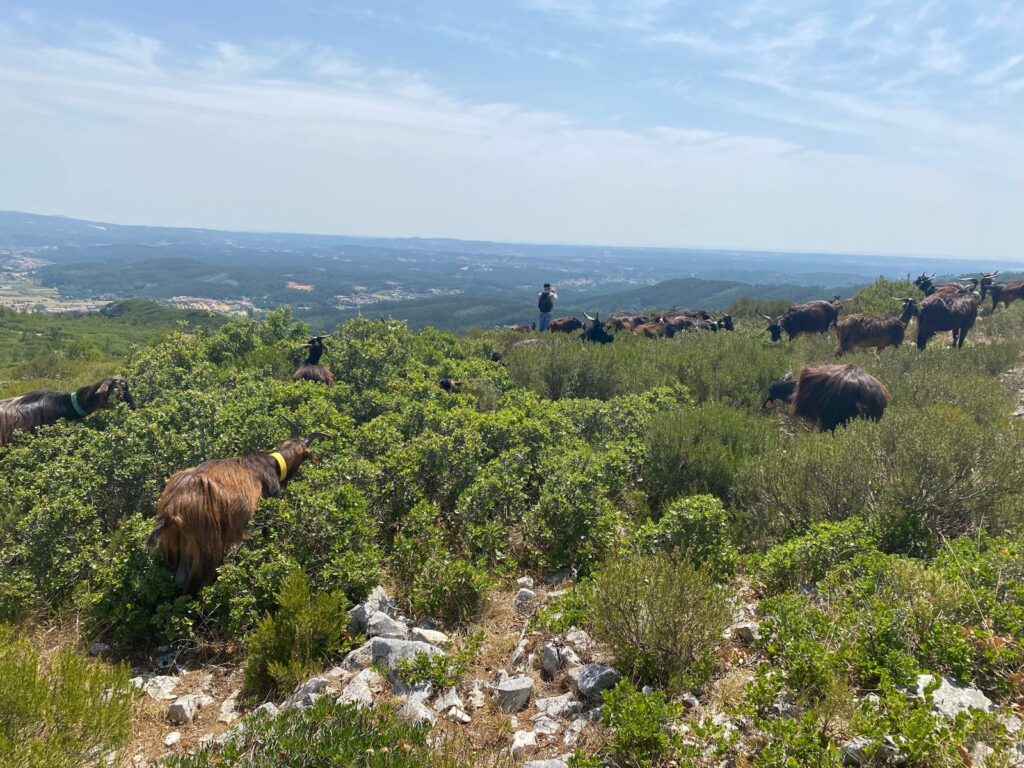
Among the paths of the Serra dos Candeeiros, the PAC National Network spent a morning in June observing the daily life of shepherds in Terra Chã, during a visit aimed at learning about local practices, promoting traditional knowledge and understanding the role of this activity in the sustainable management of the rural landscape.
The initiative forms part of the celebrations for the International Year of Pastures and Shepherds 2026, proclaimed by the United Nations and promoted by the FAO – Food and Agriculture Organisation of the United Nations, which aims to raise awareness of the contribution made by shepherds and pastures to biodiversity, food security, the resilience of territories and the preservation of ways of life deeply rooted in the landscape.
Long before the produce reaches the table, there is daily work involving care, knowledge and a connection to the land. Shepherding begins with the simple gestures of those who know the animals, follow their rhythm, identify the best routes and guide the flock according to the vegetation, the weather and the experience accumulated over generations.
During the visit, we were able to observe this daily routine at close quarters, from the very first moments in the barn right through to the herd’s departure for the mountains. Amidst the sound of cowbells, the stone paths and the characteristic vegetation of the Serra dos Candeeiros, the relationship between the animals, the landscape and the shepherds highlighted the importance of this activity for maintaining living, well-caredfor and productive landscapes.
The visit was led by Mr António and Mr Paulo, a shepherd with many years’ experience and a deep knowledge of the Serra dos Candeeiros, its trails, the local flora and the behaviour of the goats. Miguel, a shepherd representing a new generation, also took part; during the walk, he led a guided tour for a Dutch couple, sharing his knowledge of the local flora, the dynamics of the herd and the way in which pastoralism today intersects with nature tourism and efforts to enhance the area.
Sheepfarming continues to play an essential role in landscape management. The passage of flocks helps to control vegetation, maintain open spaces, enhance local resources and strike a balance between agriculture, nature and human activity. It is a sustainable practice, built on direct knowledge of the land and the ability to adapt to its conditions.
This link between pastoralism, landscape and local identity is also inextricably linked to the Mediterranean diet. In addition to the products resulting from these systems, such as cheese and other foods associated with extensive production, it is important to recognise the role of the shepherd in shaping and preserving Mediterranean landscapes. It is these practices that help to maintain agricultural and natural mosaics, to enhance local resources and to preserve ways of living, producing and consuming that are deeply rooted in Portuguese rural culture.
The preservation of native breeds is, in this context, of particular importance. Adapted to the territory, climate, vegetation and local conditions, these breeds represent a genetic, productive and cultural heritage that must be protected. Their survival depends on the promotion of the production systems that give them meaning, on recognition of the work of the breeders, and on the creation of conditions that allow these activities to continue.
In the words of the shepherds, the continuity of pastoralism also requires innovation and the ability to adapt. Improving working conditions, promoting local products, linking with rural and nature-based tourism, passing on knowledge and engaging new generations were highlighted as essential factors in making this activity more attractive to young people.
At a time when fewer and fewer people are pursuing this profession, it becomes even more important to recognise the value of those who keep this knowledge alive. Sheep farming is not merely a productive activity.
It is a way of caring for the landscape, preserving biodiversity, maintaining traditions, protecting native breeds and strengthening the identity of rural areas.
The experience of Terra Chã demonstrates how the knowledge accumulated by those who live and work in the mountains can be combined with new forms of economic and social revitalisation. Preserving pastoralism also means preserving landscapes, products, knowledge, ways of life and a balanced relationship between agriculture, nature and the community.
This work is further extended through the activities organised by the Terra Chã Cooperative, via educational and nature-based tourism experiences that introduce young people to the Community Herd, beekeeping, silvopastoralism and biodiversity. Sponsorship the herd, is another way of supporting nature conservation and the forest clearing carried out by the animals, strengthening the bond between the community, visitors and the local area.
Find out more about the experiences available to the public, such as ‘Shepherd for a Morning’ and ‘Visit to the Alcobertas Caves’, amongst others, here’